DESERT GEOLOGY FIELD NOTES · LANDFORM SCIENCE
How Nature Carves Openings Through Solid Rock
Explore the geological processes that transform cliffs and rock walls into remarkable natural arches—and discover why some formations survive while others collapse.
Natural stone arches are among the most striking landforms found on Earth.
These formations appear as curved bridges of rock spanning open spaces, sometimes rising high above desert floors, valleys, or coastal landscapes.
At first glance, they may seem almost impossible.
How can a massive rock formation develop an opening beneath it without immediately collapsing?
The answer involves a combination of geological structure, weathering, erosion, and the mechanical strength of rock.
Natural arches do not usually form through one sudden event.
Instead, they develop as natural processes gradually remove weaker material while stronger sections remain standing.
The formation of a natural stone arch depends on where rock breaks down, how loosened material is removed, and whether the remaining structure can support its own weight.
Understanding these processes reveals how landscapes evolve over thousands to millions of years.
What Is a Natural Stone Arch?
A natural stone arch is a rock formation containing an opening beneath a continuous span of rock.
The opening develops through natural geological processes rather than human construction.
Natural arches occur in several environments.
They are especially well known in sandstone landscapes, but arches can also form in limestone and other rock types.
Some appear in dry desert regions where exposed rock is shaped by weathering and erosion.
Others form along coastlines where waves attack cliffs and headlands.
Despite their different settings, these formations share an important characteristic.
The surrounding rock must be removed selectively while enough material remains to create a stable span.
The size, shape, and durability of an arch depend on local geology and environmental conditions.
The Difference Between Weathering and Erosion
Weathering and erosion are closely related processes, but they are not identical.
Weathering refers to the breakdown or alteration of rock at or near Earth’s surface.
It can occur through physical, chemical, or biological processes.
Erosion involves the removal and transport of rock fragments or other material by agents such as water, wind, ice, or gravity.
For natural arch formation, weathering often weakens the rock or separates fragments.
Erosion then helps carry the loosened material away.
These processes may operate together over long periods.
For example, water entering a fracture may weaken surrounding rock, while runoff later removes sediment and broken pieces.
Repeated cycles can gradually enlarge an opening.
GEOLOGY REFERENCE CARD
Weathering Breaks Rock Down. Erosion Moves the Material Away.
Both processes can contribute to arch formation, but the importance of each depends on the rock type, climate, fractures, and landscape setting.
Why Sandstone Is Common in Natural Arch Landscapes
Sandstone is a sedimentary rock formed from sand-sized grains that have been compacted and cemented together.
Its properties vary depending on the mineral composition, cement, grain size, and geological history.
Some sandstone formations contain strong layers separated by weaker zones.
Others develop fractures and joints that create pathways for weathering.
These characteristics can encourage selective removal of rock.
In suitable conditions, weaker material breaks down while more resistant sections remain.
Sandstone landscapes may also contain narrow rock walls called fins.
Fins can develop when erosion removes surrounding rock along fractures and joints.
Some natural arches eventually form within these exposed rock walls.
However, sandstone does not automatically produce arches.
The formation process requires an appropriate combination of structure, weathering, erosion, and stability.
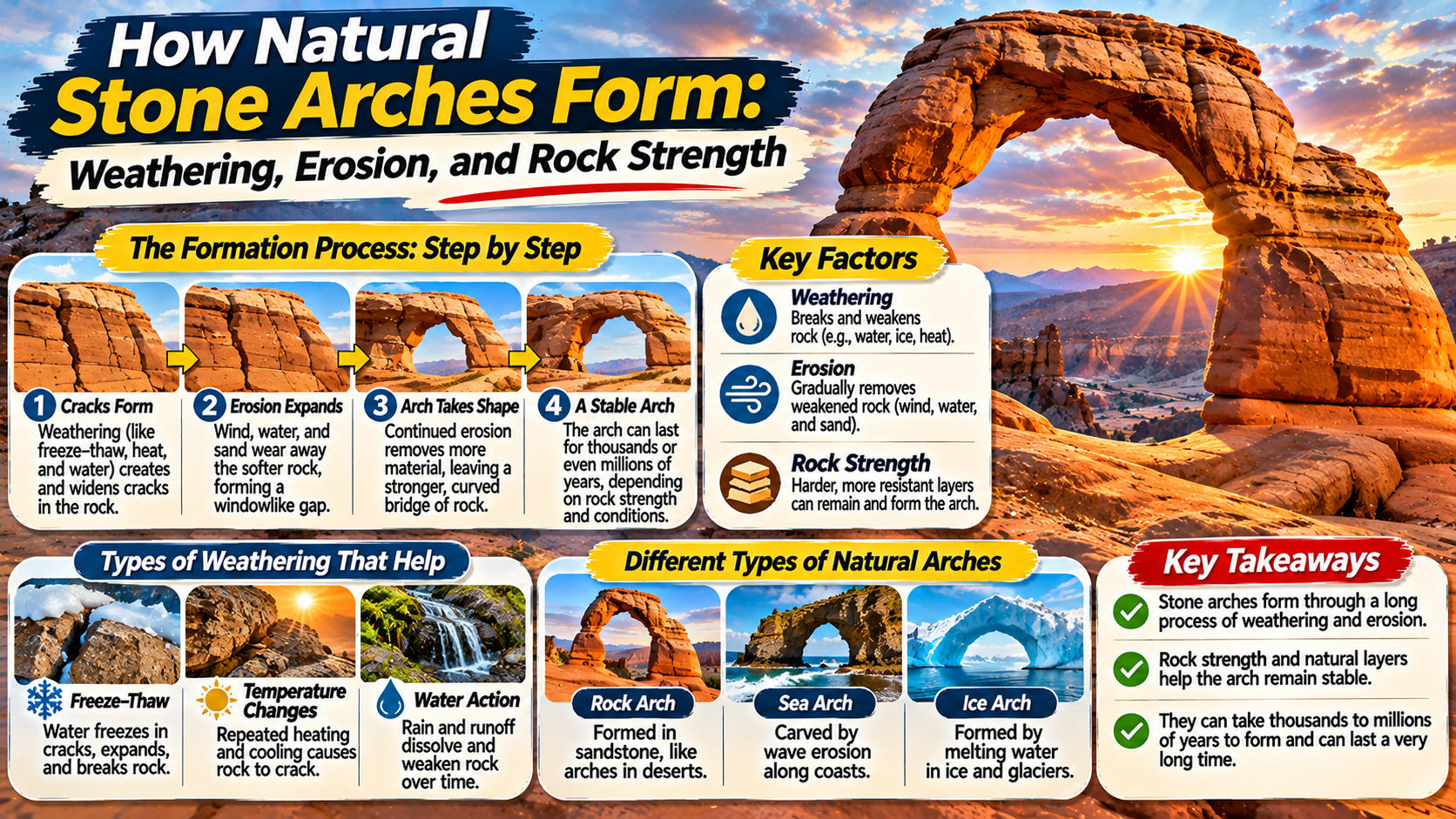
How Natural Stone Arches Form Step by Step
Although individual arches have different geological histories, many sandstone arches develop through a sequence of related processes.
The process often begins with exposed rock containing fractures or other zones of weakness.
Weathering and erosion gradually enlarge these weaknesses.
As surrounding material disappears, narrow rock walls or fins may remain.
Further weathering can create cavities or openings within these structures.
If the remaining rock is sufficiently strong, an arch can persist.
LANDFORM DEVELOPMENT / FIVE STAGES
Joints, cracks, and other weaknesses divide the rock mass.
Water, temperature changes, salts, and other processes affect exposed surfaces.
Loose fragments and sediment are transported away, exposing more rock.
Selective breakdown creates a cavity that may develop into a complete opening.
The remaining structure forms an arch, provided it can support the forces acting upon it.
How Cracks and Joints Influence Arch Formation
Natural fractures play a major role in shaping many rock landscapes.
Joints are cracks in rock along which little or no significant displacement has occurred.
They may develop through geological stresses, cooling, unloading, or other processes.
Once exposed at the surface, joints can provide pathways for water and other weathering agents.
Rock along these weaknesses may break down more quickly than surrounding material.
This can divide large rock masses into smaller blocks or narrow walls.
In sandstone regions, closely spaced joints can help create the fins from which some arches develop.
The orientation and spacing of fractures influence the eventual shape of the landform.
However, fractures alone are not sufficient.
The remaining rock must also withstand mechanical stresses as the opening grows.
The Role of Water in Weathering Rock
Water is one of the most important agents involved in rock weathering.
Rainwater can enter fractures, pores, and bedding planes.
In cold environments, water may freeze and expand, placing pressure on surrounding rock.
Repeated freezing and thawing can contribute to fracture enlargement where conditions are suitable.
Water also participates in chemical reactions that alter certain minerals.
In some rock types, dissolution removes material directly.
Surface runoff can transport loosened sediment away from exposed rock.
Over time, these processes may enlarge cavities and openings.
The importance of water varies greatly between humid, arid, coastal, and high-altitude environments.
Salt Weathering in Desert Environments
Salt weathering can contribute to the breakdown of porous rocks, including sandstone.
Water carrying dissolved salts may enter small spaces within the rock.
As the water evaporates, salts can crystallize inside pores and fractures.
Crystal growth and related processes may exert stresses on the surrounding material.
Repeated cycles can gradually weaken rock surfaces.
In some desert environments, this contributes to granular disintegration and the enlargement of small cavities.
However, salt weathering is only one of several possible mechanisms.
Its effectiveness depends on the type of salt, moisture conditions, pore structure, and rock composition.
Does Wind Carve Natural Stone Arches?
Wind is often associated with desert landforms, but its role in arch formation is sometimes exaggerated.
Wind can transport sand and dust, and wind-driven particles can abrade exposed rock surfaces.
However, many large sandstone arches form primarily through processes involving rock structure, water-related weathering, and the removal of weakened material.
Wind erosion may contribute to shaping some surfaces, but it is not necessarily the main cause of an arch.
Different arches form through different combinations of processes.
Understanding the local geology is essential before identifying the dominant cause.
How Rock Strength Keeps an Arch Standing
Creating an opening is only part of the challenge.
The remaining rock must support its own weight.
As material disappears beneath a rock span, the distribution of mechanical stress changes.
Some parts of the remaining structure experience compression, while others may experience tension or shear.
Rock generally behaves differently under these types of stress.
Many rocks are relatively strong in compression but weaker in tension.
The shape of an arch can help distribute loads through the remaining rock.
However, natural arches are irregular structures rather than perfectly engineered masonry arches.
Their stability depends on rock strength, fractures, geometry, and environmental conditions.
As weathering continues, the span may become thinner or develop new cracks.
Eventually, some arches collapse when their remaining strength is insufficient to resist the forces acting on them.
ROCK MECHANICS / FIELD OBSERVATION
An Arch Exists Because Rock Has Been Removed—and Survives Because Enough Strength Remains.
The balance between continued weathering and structural stability determines how long a natural arch can persist.
Why Some Natural Arches Are Thin and Others Are Massive
Natural arches display an extraordinary variety of shapes.
Some have slender spans extending across wide openings.
Others consist of thick rock bridges with relatively small openings beneath them.
These differences reflect variations in geology and weathering history.
Rock layers may differ in strength, cementation, and fracture patterns.
The position of an opening within a rock wall can also influence how stress is distributed.
In some cases, the surrounding landform provides substantial support.
In others, a narrow span remains exposed to continued weathering.
Because these factors interact, arch appearance alone cannot reliably reveal its age or remaining lifespan.
Natural Arches vs. Natural Bridges
The terms natural arch and natural bridge are sometimes used interchangeably, but geologists and park managers may distinguish them based on formation processes.
Natural bridges are commonly associated with stream erosion.
For example, a river may cut through a narrow rock wall or erode a passage beneath a resistant rock span.
Natural arches can form through a wider range of processes, including weathering along fractures and selective erosion.
However, naming conventions vary, and the distinction is not always applied consistently.
The most useful approach is to examine the geological history of the individual landform.
How Coastal Sea Arches Form
Natural arches are not limited to deserts.
Along rocky coastlines, waves can create openings through headlands and cliffs.
Wave action concentrates energy against exposed rock surfaces.
Fractures and weaker zones may gradually develop into caves.
If erosion enlarges caves from opposite sides of a headland, they may eventually connect.
This creates a sea arch.
Continued erosion and weathering can weaken the roof of the opening.
If the arch collapses, an isolated rock pillar called a sea stack may remain.
Coastal arches therefore demonstrate a different pathway to a similar landform.
Comparing Different Types of Natural Arches
| Arch Type | Common Environment | Important Formation Processes |
|---|---|---|
| Sandstone arch | Desert and plateau landscapes | Fracture-controlled weathering and erosion |
| Sea arch | Rocky coastlines | Wave erosion and weathering |
| Natural bridge | River valleys and canyons | Stream erosion and related processes |
| Limestone arch | Karst landscapes | Dissolution, cave development, and collapse |
Famous Natural Stone Arches Around the World
Delicate Arch — Utah, United States
Delicate Arch is one of the best-known natural sandstone arches in the world.
Located in Arches National Park, it stands as a prominent example of the region’s distinctive geology.
The surrounding landscape contains sandstone formations shaped by fractures, weathering, and erosion.
Landscape Arch — Utah, United States
Landscape Arch is famous for its exceptionally long and slender sandstone span.
Its appearance demonstrates how a large opening can exist beneath a relatively thin section of rock.
The formation also illustrates the importance of structural stability in natural arches.
Durdle Door — Dorset, England
Durdle Door is a well-known coastal limestone arch along England’s Jurassic Coast.
It formed through the interaction of marine erosion and the geological structure of the coastline.
Unlike many desert sandstone arches, its development is strongly associated with wave action.
Why Natural Arches Eventually Collapse
Natural arches are temporary features on geological timescales.
Weathering continues after an arch forms.
Rain, temperature changes, chemical reactions, and other processes may gradually weaken the remaining rock.
Fractures can enlarge, and small pieces may detach from the span.
As the structure changes, stress becomes redistributed.
Eventually, the remaining rock may no longer support its own weight.
Collapse can occur suddenly, even after a long period of gradual weakening.
Individual collapses may be influenced by rainfall, freeze-thaw activity, earthquakes, or other triggers, but identifying a single cause is not always possible.
Because of these risks, visitors should follow safety restrictions and avoid entering closed areas around unstable formations.
How Scientists Study Natural Arches
Geologists investigate natural arches by examining rock composition, fractures, and surrounding landforms.
Field measurements help document arch dimensions and geological structures.
Photographic surveys and three-dimensional scanning can record changes in shape over time.
Researchers may also study rock strength and the distribution of mechanical stress.
Remote sensing and digital terrain models provide additional information about landscape evolution.
These methods help scientists understand how arches develop and how they may change in the future.
However, predicting the exact time of an arch collapse remains difficult because natural rock structures contain many uncertainties.
Frequently Asked Questions
How do natural stone arches form?
They form when weathering and erosion remove rock from a larger formation while a sufficiently strong span remains above the opening.
What is the difference between weathering and erosion?
Weathering breaks down or alters rock, while erosion removes and transports material.
Why are natural arches common in sandstone?
Some sandstone formations contain fractures, layers, and variable rock strengths that encourage selective weathering and erosion.
Does wind create natural arches?
Wind can contribute to erosion, but many natural arches form primarily through other processes involving water, fractures, and rock weathering.
How long does it take for a natural arch to form?
Formation times vary widely and can extend over thousands to millions of years, depending on geological conditions.
Why don’t natural arches collapse immediately?
The remaining rock can support its weight when its geometry and mechanical strength are sufficient to resist the stresses acting on it.
Do natural arches last forever?
No. Continued weathering and erosion eventually weaken many arches, and some collapse when their remaining structure becomes unstable.
Final Thoughts
Natural stone arches are remarkable examples of how geological processes shape Earth’s surface.
Their formation begins with the structure and properties of the surrounding rock.
Fractures, differences in rock strength, and environmental conditions influence where weathering occurs.
Erosion removes weakened material, gradually enlarging openings beneath resistant rock spans.
The remaining structure survives only while it can withstand the forces acting upon it.
Over time, continued weathering may weaken the arch until collapse becomes inevitable.
From sandstone formations in desert landscapes to limestone arches along rocky coastlines, these landforms demonstrate the complex relationship between geology, climate, and mechanical strength.
Natural arches are therefore not permanent monuments but changing features within Earth’s evolving landscapes.