How to Identify Minerals Using Hardness, Streak, Luster, and Cleavage
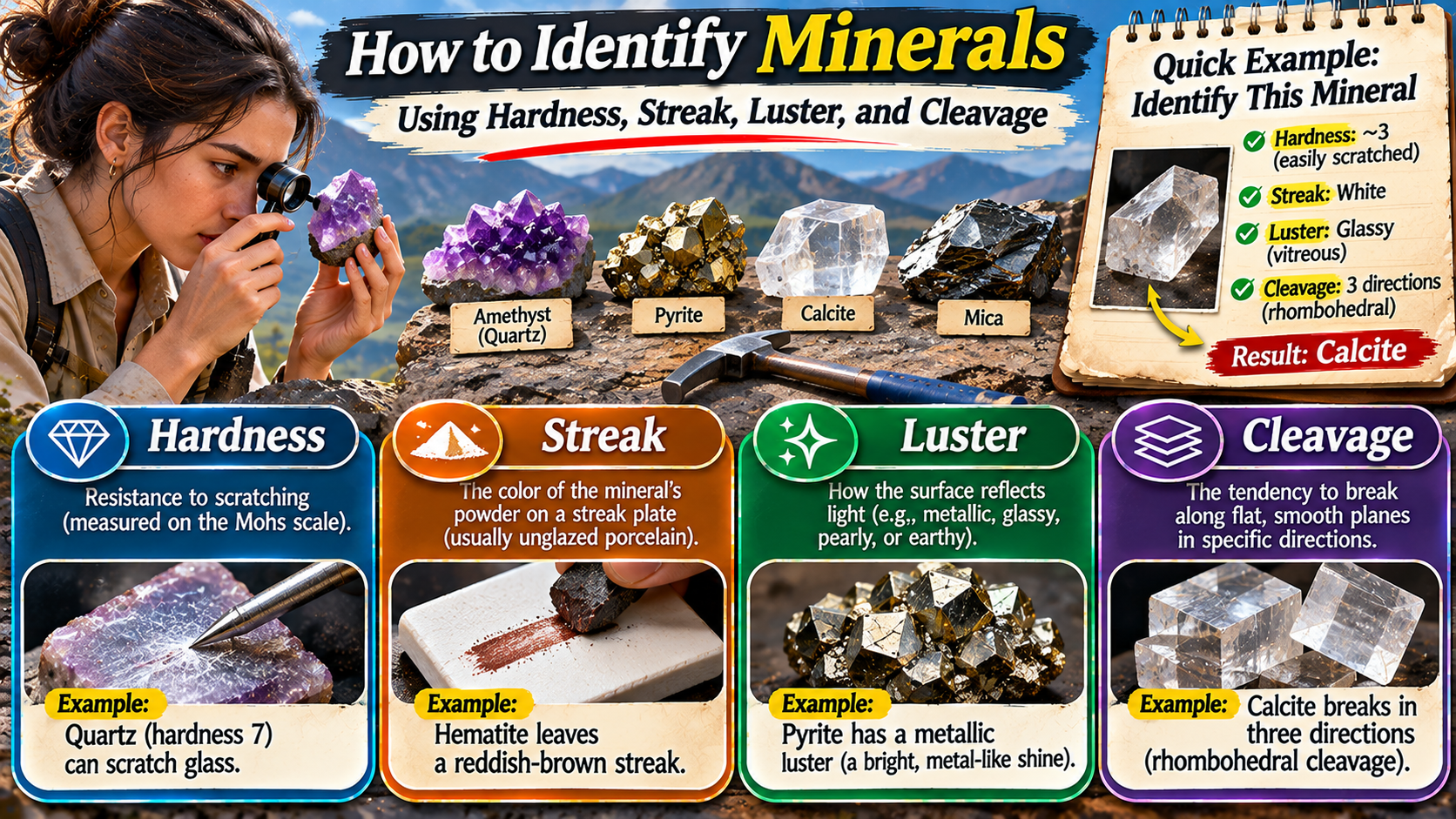
EARTH SCIENCE FIELD LAB ยท MINERAL IDENTIFICATION Reading the Hidden Clues Inside Minerals Learn how geologists use four essential physical properties to distinguish minerals and recognize common specimens. HARDNESS STREAK LUSTER CLEAVAGE Imagine finding an unusual mineral specimen during a hike. It has a shiny surface, a pale color, and several flat faces. At first … Read more

Physical Mineralogy: Mohs Hardness Scale, Cleavage Crystallography, Birefringence, and Piezoelectricity

Geological illustration of Physical Mineralogy: Mohs Hardness Scale, Cleavage Crystallography, Birefringence, and Piezoelectricity

๐Ÿ’Ž Physical Mineralogy: The Macroscopic Window to Atomic Bonding Physical mineralogy investigates the macroscopic mechanical, optical, electrical, and magnetic properties of minerals. These observable physical characteristics are not arbitrary quirks of nature; they are the direct, deterministic manifestation of internal crystal chemistry, atomic packing densities, and the spatial anisotropy of chemical lattice bonds. 1. The … Read more

Non-Silicate Ore Minerals: Sulfides, Native Elements, Oxides, and Hydrothermal Vein Metallogeny

Geological illustration of Non-Silicate Ore Minerals: Sulfides, Native Elements, Oxides, and Hydrothermal Vein Metallogeny

โ›๏ธ Economic Metallogeny: Concentration of Rare Elements from the Crust While silicate minerals form the bulk rock mass of Earth’s crust, human civilization is powered by non-silicate minerals: the sulfides, oxides, carbonates, and native elements that constitute commercial metal ores. Because essential industrial metals (such as copper, gold, lead, zinc, and lithium) have crustal abundances … Read more

Crystallography and Space Groups: Miller Indices, Bravais Lattices, and X-Ray Powder Diffraction (XRD)

Geological illustration of Crystallography and Space Groups: Miller Indices, Bravais Lattices, and X-Ray Powder Diffraction (XRD)

๐Ÿ”ฎ Crystallographic Core: The Symmetry of Ordered Matter A mineral is scientifically defined not merely by its chemical composition, but by its internal, orderly, repeating three-dimensional arrangement of atomsโ€”its crystalline lattice. Crystallography provides the rigorous mathematical framework that bridges the sub-angstrom atomic world with the macroscopic morphology, cleavages, and optical properties of mineral crystals. 1. … Read more

Silicate Mineralogy: Tectosilicate Frameworks, Phyllosilicate Sheets, and Inosilicate Chain Coordination

Geological illustration of Silicate Mineralogy: Tectosilicate Frameworks, Phyllosilicate Sheets, and Inosilicate Chain Coordination

๐Ÿ’Ž Mineralogical Cornerstone: The Silicon-Oxygen Tetrahedron Silicate minerals constitute over 90 percent of the Earth’s crust and virtually the entire mantle. The fundamental architectural building block of all silicates is the silicon-oxygen tetrahedron [SiOโ‚„]โดโป, consisting of a central tetravalent silicon cation (Siโดโบ) coordinated with four divalent oxygen anions (Oยฒโป) in a robust, covalently bonded tetrahedral … Read more