🌱 Exogenic Petrology: The Deconstruction of Solid Rock into Living Soil
Weathering is the foundational interface where the solid geosphere interacts with the hydrosphere, atmosphere, and biosphere. Operating through coupled mechanical disintegration and chemical decomposition, weathering transforms massive, high-temperature crystalline bedrock into loose, weathered regolith and fertile soils. In doing so, weathering controls global river chemistry, buffers atmospheric carbon dioxide across geological epochs, and prepares detritus for sedimentary transport.
1. Mechanical Weathering: Disintegration and Surface Area Amplification
Mechanical (physical) weathering involves the physical disintegration of solid rock masses into progressively smaller fragments without altering the fundamental mineralogical or chemical composition of the material. Beyond breaking rock, mechanical weathering’s most vital thermodynamic role is exponential surface area amplification:
Consider a 1-meter cube of solid granite with an initial surface area of 6 square meters. If mechanical fracturing divides this block into 1-millimeter cubes, the total volume remains identical, but the total exposed surface area explodes by a factor of 1,000 to 6,000 square meters. Because chemical reactions occur exclusively at mineral-fluid interfaces, mechanical weathering acts as the essential kinetic catalyst for chemical decomposition.
The primary mechanical weathering engines include:
- 1. Frost Wedging (Cryoclasty): When liquid water freezes into hexagonal Ice-Ih at 0°C, its volume expands by approximately 9.05 percent. In confined bedrock micro-cracks subjected to daily freeze-thaw cycles, this volumetric expansion generates hydrostatic pressures exceeding 200 megapascals (MPa)—far surpassing the tensile strength of granite (~7 to 15 MPa)—wedging open joints and shattering rock into angular felsenmeer and talus slopes.
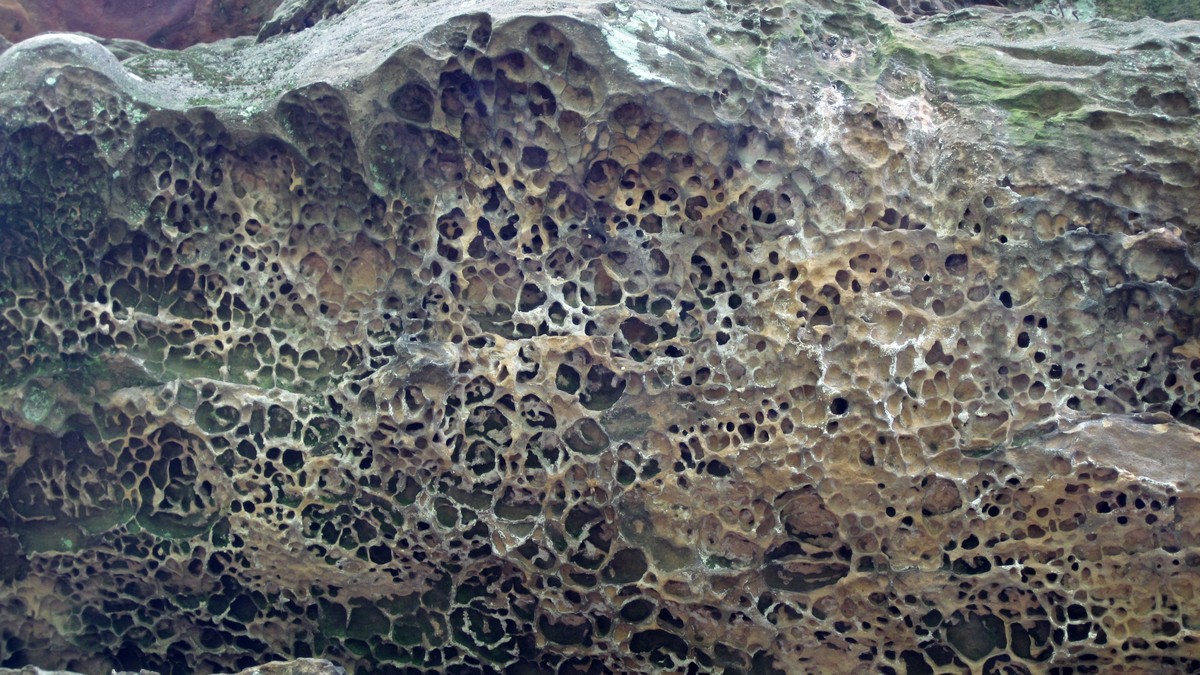
- 2. Salt Crystal Growth (Haloclasty): In arid climates and coastal spray zones, saline groundwater evaporates within rock pores, precipitating halite, thenardite, and gypsum crystals. Crystal growth and thermal expansion of salt lattices generate immense internal crystallization pressures, causing tafoni honeycomb weathering and cavernous hollows.
- 3. Thermal Stress Fatigue (Insolation Weathering): Rapid diurnal heating and cooling cycles in deserts (rock surface temperatures swinging from 0°C at night to >60°C at noon) induce steep thermal expansion gradients between mineral grains of differing thermal expansion coefficients (quartz expands twice as much as feldspar), triggering micro-crack propagation and granular disintegration.
- 4. Biomechanical Wedging: Expanding plant root systems penetrate bedrock fractures, exerting hydraulic turgor pressures of 0.5 to 1.5 MPa that physically pry open joint blocks.
2. Chemical Weathering: The Molecular Decomposition of Primary Silicates
While mechanical weathering fragments rock, chemical weathering attacks the primary covalent and ionic bonds of high-temperature minerals formed under deep-Earth conditions, transforming them into secondary hydrated phases stable at ambient surface temperature (25°C, 1 bar). Four primary chemical mechanisms operate in nature:
1. Carbonation and Hydrolysis: The most significant chemical weathering reaction on Earth. Meteoric water absorbs atmospheric and soil-derived carbon dioxide, generating carbonic acid (H₂CO₃), which dissociates into hydrogen ions (H⁺) and bicarbonate (HCO₃⁻). The aggressive H⁺ ions attack the tectosilicate lattice of feldspars, exchanging for alkali and alkaline-earth cations. In the weathering of potassium feldspar (orthoclase):
2 KAlSi₃O₈ + 2 H⁺ + 9 H₂O → Al₂Si₂O₅(OH)₄ (Kaolinite) + 2 K⁺ + 4 H₄SiO₄
This reaction dissolves soluble potassium and silica into groundwater while transforming hard feldspar into soft, malleable kaolinite clay.
2. Oxidation: Ferrous iron (Fe²⁺) within mafic silicates (biotite, augite, olivine) and sulfides (pyrite) reacts with dissolved atmospheric oxygen, oxidizing into ferric iron (Fe³⁺). Because Fe³⁺ has a smaller ionic radius and higher charge, the crystal lattice destabilizes, precipitating insoluble, rusty-red ferric oxyhydroxides: goethite (α-FeO(OH)) and hematite (Fe₂O₃).
3. Chelation: Soil organic acids (oxalic, citric, and fulvic acids secreted by tree roots, lichens, and mycorrhizal fungi) form ring-structured organic complexes with multivalent metal cations (Al³⁺, Fe³⁺), dramatically increasing their solubility and stripping them from bedrock matrices.
| Primary Mineral | Bowen’s Reaction Series Rank | Weathering Susceptibility | Dominant Weathering Reaction | Residual Secondary Products |
|---|---|---|---|---|
| Olivine (Forsterite) | First to crystallize (High-T) | Ultra-High (breaks down in days/years) | Dissolution & Oxidation | Serpentine, Goethite, dissolved Mg²⁺ & silicic acid |
| Ca-Plagioclase (Anorthite) | Early crystallization (High-T) | Very High | Hydrolysis & Carbonation | Kaolinite, Smectite clays, dissolved Ca²⁺ |
| Pyroxene (Augite) | High temperature mafic | High | Hydrolysis & Fe-Oxidation | Chlorite, Smectite, Hematite, dissolved ions |
| Amphibole (Hornblende) | Intermediate mafic | Moderate to High | Hydrolysis & Fe-Oxidation | Illite, Smectite, Goethite |
| Biotite Mica | Intermediate felsic | Moderate | Oxidation & K-loss expansion | Vermiculite, Chlorite, dissolved K⁺ |
| K-Feldspar (Orthoclase) | Late crystallization | Low | Acid Hydrolysis | Kaolinite clay, dissolved K⁺ and silica |
| Muscovite Mica | Late crystallization | Very Low | Hydrolysis | Illite clay, dissolved K⁺ |
| Quartz (SiO₂) | Last to crystallize (Lowest-T) | Ultra-Low (Nearly Indestructible) | Slow congruent dissolution | Residual quartz sand grains (detrital arenite) |
3. Goldich’s Dissolution Series: The Inverted Bowen’s Reaction Series
In 1938, American geochemist Samuel Goldich established an empirical rule that governs the relative weathering resistance of common rock-forming minerals: Goldich’s Dissolution Series. Goldich discovered that the relative stability of a mineral under surface weathering conditions is the exact inverse of its crystallization sequence in Bowen’s Reaction Series!
The thermodynamic explanation for this correspondence lies in the degree of disequilibrium between the mineral’s crystallization environment and ambient Earth surface conditions:
- High-Temperature Minerals (Olivine, Anorthite): Crystallized at extreme magmatic temperatures (1,200°C–1,400°C) and anhydrous conditions, possessing isolated silica tetrahedra or weak framework substitutions. When exposed to 25°C liquid water charged with oxygen and carbonic acid, they sit in extreme thermodynamic disequilibrium. Their chemical bonds are easily severed, causing rapid decomposition.
- Low-Temperature Minerals (Quartz): Crystallized at the lowest magmatic temperatures (~600°C–700°C) as a completely polymerized framework of strong, covalent Si-O-Si bonds containing zero iron or magnesium. At Earth’s surface, quartz is closest to its thermodynamic stability field; its solubility in neutral water is merely ~6 to 10 ppm, making it exceptionally resistant to weathering and allowing it to dominate global beach sands and sandstone formations.
🪨 Pedological Benchmark: Spheroidal Weathering and Corestones
When jointed granite batholiths undergo subsurface chemical hydrolysis along orthogonal fractures, chemical attack is concentrated at the corners (attacked from three directions) and edges (two directions), rounding square blocks into giant spheroidal corestones encased in concentric onion-like shells of decomposed, crumbly granite termed grus.
4. Regolith and Soil Profile Genesis: The Master Soil Horizons
The continuous progression of mechanical fracturing and chemical hydrolysis transforms unweathered bedrock (R horizon) into a vertical continuum of unconsolidated weathered debris termed regolith, the upper biologically active portion of which is soil. Under the influence of Hans Jenny’s five state factors of soil formation (Climate, Organisms, Relief, Parent Material, and Time), water percolation establishes a vertically differentiated profile characterized by master soil horizons:
- O Horizon (Organic Layer): Decomposing forest leaf litter, humified organic matter, and active macro/micro-organisms.
- A Horizon (Topsoil): Mineral horizon intensely enriched with humified dark organic matter; zone of intense biological activity and seed germination.
- E Horizon (Eluviation Zone): Leached, light-colored horizon from which percolating organic acids have stripped clays, iron oxides, and aluminum, leaving a bleached residue of resistant quartz and silicate silt.
- B Horizon (Subsoil / Illuviation Zone): The accumulation horizon where clays, iron/aluminum sesquioxides, and secondary carbonates illuviated from above are deposited, developing distinctive soil structure (blocky, prismatic).
- C Horizon (Weathered Substratum): Partially disintegrated and chemically altered parent bedrock (saprolite) retaining ghost structures of primary bedding or foliation, devoid of pedogenic properties.
- R Horizon (Bedrock): Unweathered, consolidated parent crystalline rock.
5. Extreme Tropical Weathering: Laterites and Bauxite Ore Deposits
In humid tropical climates characterized by high mean annual temperatures (>25°C), immense rainfall (>2,000 mm/yr), and millions of years of tectonic stability (such as the Amazon Basin, West Africa, and Western Australia), chemical weathering reaches its ultimate geological expression: lateritization.
Under intense, continuous leaching by warm acidic rainwater, not only are all alkalis (Na, K, Ca, Mg) completely stripped from the bedrock, but even silica (SiO₂) itself is dissolved and flushed out of the profile (desilication). Kaolinite clay is broken down, leaving behind a residual crust composed solely of insoluble iron and aluminum oxides and hydroxides.
The resulting weathered profile is a deep, brick-red laterite. When the parent bedrock is rich in aluminum and poor in iron (such as nepheline syenites or aluminous clays), extreme leaching produces bauxite—the primary global ore of aluminum, composed of gibbsite (Al(OH)₃), boehmite (γ-AlO(OH)), and diaspore (α-AlO(OH)). Bauxite deposits represent the final residual exhaustion of silicate weathering, where an entire mountain range of granite is reduced to a residual cap of pure aluminum ore.
6. The Silicate Weathering Feedback: Earth’s Long-Term Planetary Thermostat
On geological timescales of hundreds of thousands to millions of years, chemical silicate weathering acts as Earth’s premier natural planetary thermostat, preventing our planet from experiencing runaway greenhouse overheating or permanent snowball glaciation (the Walker Feedback Hypothesis).
Because the kinetic rate of silicate mineral hydrolysis is strongly temperature-dependent (governed by the Arrhenius equation) and precipitation-dependent: if volcanic emissions pump excess CO₂ into the atmosphere, global temperatures rise and the hydrological cycle accelerates. Warmer, wetter conditions dramatically speed up chemical weathering of continental silicates, drawing CO₂ out of the atmosphere at accelerated rates and burying it as marine carbonates. Conversely, if Earth cools, weathering rates plummet, allowing volcanic CO₂ to accumulate in the atmosphere until warming resumes. This negative feedback loop has maintained liquid oceans and habitable conditions on Earth for nearly 4 billion years.
7. Microbial and Fungal Bioweathering: The Geo-Biological Interface
While abiotic mechanical and chemical weathering processes operate continuously, modern biogeochemistry demonstrates that biological organisms actively accelerate bedrock weathering by up to three orders of magnitude. This synergistic interaction is termed bioweathering.
Pioneering organisms—specifically epilithic and endolithic lichens (symbiotic associations of fungi and cyanobacteria/algae)—colonize bare rock surfaces. Fungal hyphae penetrate microscopic grain boundaries and micro-fractures, exerting mechanical hyphal turgor wedging forces that pry apart individual mineral grains. Concurrently, lichens secrete concentrated cocktails of specialized organic acids, including oxalic acid, lichenic acid, and usnic acid. Oxalate anions act as powerful bidentate chelating ligands, binding tightly to divalent iron, calcium, and magnesium cations in pyroxenes and plagioclase.
Furthermore, subterranean mycorrhizal fungal networks associated with tree roots directly attack mineral grains, actively extracting essential nutrient elements (phosphorus from apatite, potassium from feldspars, magnesium from biotite) by localized acidification down to pH 2. This direct biological mining of bedrock accelerates the global carbon drawdown and drives the rapid formation of productive forest soils.
8. Quantitative Weathering Indices: Chemical Index of Alteration (CIA)
To quantitatively evaluate the intensity of chemical weathering preserved within ancient sedimentary rocks and modern soil profiles, geochemists calculate standardized molecular weathering indices based on major element oxide concentrations determined by X-ray Fluorescence (XRF) spectrometry. The most universally applied metric is the Chemical Index of Alteration (CIA), formulated by Wayne Nesbitt and Grant Young:
CIA = [Al₂O₃ / (Al₂O₃ + CaO* + Na₂O + K₂O)] × 100
where all components are expressed in molar proportions, and CaO* represents calcium incorporated strictly within silicate minerals (excluding carbonates and apatite). The CIA measures the progressive loss of mobile alkali and alkaline-earth cations (Ca²⁺, Na⁺, K⁺) relative to immobile, refractory aluminum (Al³⁺):
- Fresh Unweathered Igneous Rocks: Granite, basalt, and diorite exhibit baseline CIA values between 45 and 55.
- Moderate Weathering: Illite- and smectite-bearing soils in temperate climates display CIA values of 60 to 75.
- Intense Tropical Weathering: Kaolinite- and bauxite-dominated residual soils, as well as highly mature quartz arenites, yield CIA values approaching 90 to 100.
🪨 Geochemical Paleoclimatology Landmark
By analyzing CIA values in ancient shale sequences across geological boundaries, paleoclimatologists reconstruct major planetary warming events, such as the Paleocene-Eocene Thermal Maximum (PETM, ~56 Ma), when global CIA spiked dramatically due to accelerated greenhouse-driven continental weathering.
9. Acid Mine Drainage and Environmental Weathering Kinetics
When subsurface mineral deposits containing sulfide minerals (particularly pyrite, FeS₂) are excavated and exposed to atmospheric oxygen and water during commercial mining, natural chemical weathering accelerates into an environmental catastrophe known as Acid Mine Drainage (AMD). The oxidation of pyrite proceeds via a multi-stage catalytic cascade:
2 FeS₂ + 7 O₂ + 2 H₂O → 2 Fe²⁺ + 4 SO₄²⁻ + 4 H⁺
The reaction produces concentrated sulfuric acid. As pH drops below 3.5, acidophilic iron-oxidizing bacteria (such as Acidithiobacillus ferrooxidans) catalyze the oxidation of ferrous iron to ferric iron (Fe³⁺), speeding up reaction rates by a factor of 100,000! Ferric iron acts as an aggressive chemical oxidant that leaches toxic heavy metals (arsenic, cadmium, lead, copper) from surrounding rocks. Remediating AMD requires active alkaline neutralization (adding lime or limestone) and passive constructed wetlands that induce bacterial sulfate reduction, illustrating how understanding weathering chemistry is crucial for environmental stewardship.