GEMOLOGY JOURNAL · MINERALS & OPTICAL SCIENCE
The Hidden Science Behind Gemstone Colors
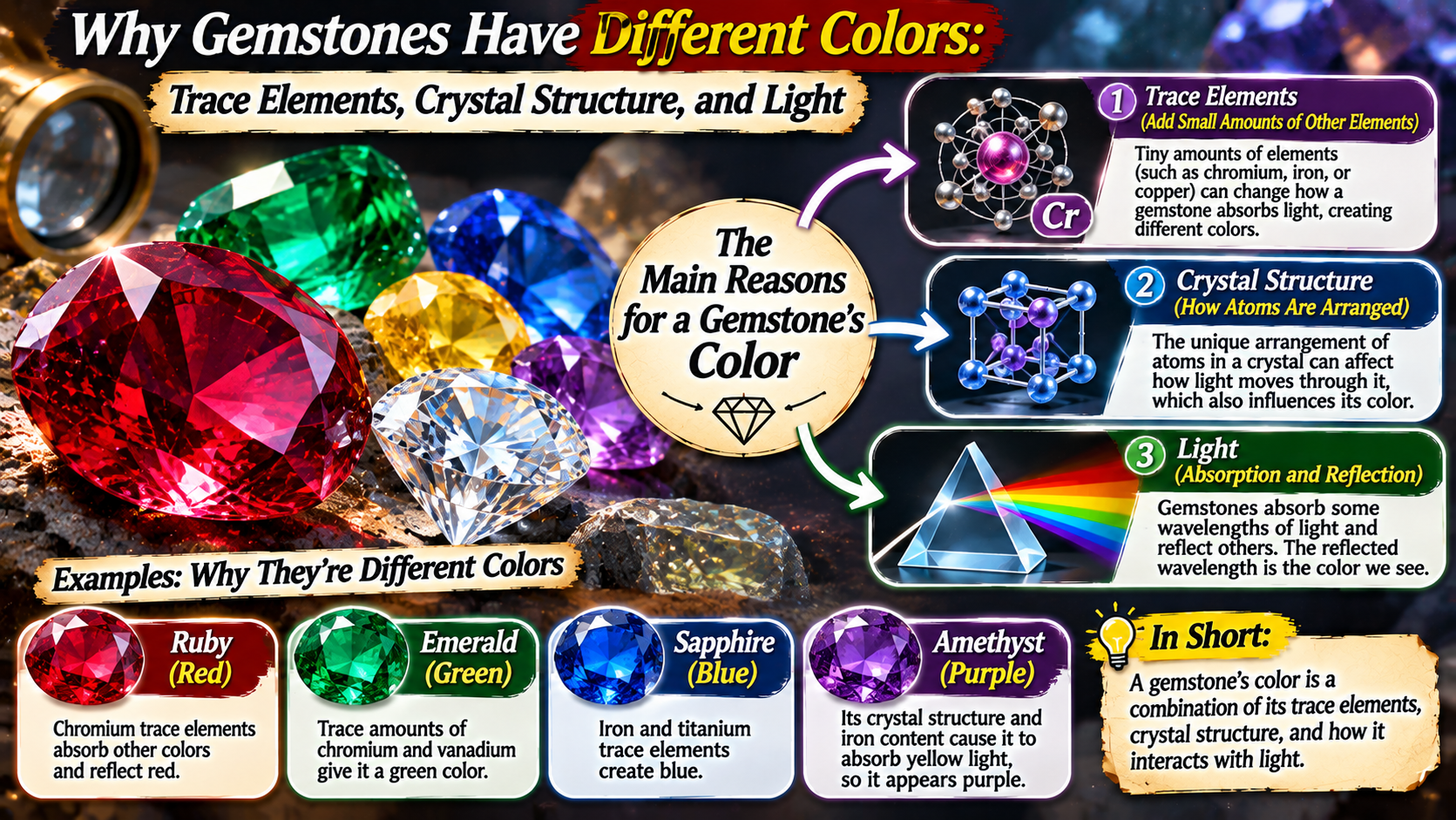
Explore how tiny amounts of chemical elements, crystal structures, and interactions with light create the remarkable colors of natural gemstones.
Gemstones display an extraordinary range of colors.
Rubies are famous for their red appearance, emeralds for their green color, and sapphires for their many shades, including deep blue.
Other minerals can appear purple, yellow, orange, pink, or nearly colorless.
These colors are not simply decorative features. They reveal important information about a gemstone’s chemistry and internal structure.
In many cases, extremely small amounts of particular chemical elements can dramatically change how a mineral interacts with light.
Crystal defects, radiation exposure, and microscopic inclusions can also influence appearance.
Gemstone color results from the interaction between light and the atomic-scale properties of a mineral.
Understanding these processes helps explain why closely related gemstones can look completely different.
What Gives a Gemstone Its Color?
Most gemstones are crystalline minerals, although some gem materials are noncrystalline or organic.
When light enters a gemstone, several things can happen.
Some wavelengths may be absorbed by the material.
Others may pass through, reflect from surfaces, or scatter inside the stone.
The light that eventually reaches an observer’s eyes determines the gemstone’s perceived color.
For example, a gemstone that absorbs much of the blue and green portions of visible light may appear red because more red light remains available to reach the eye.
The exact result depends on the mineral’s absorption characteristics and the lighting conditions.
Color can also vary with the direction from which a gemstone is viewed.
This is particularly important in certain crystals that interact differently with light traveling along different crystallographic directions.
Trace Elements: Small Impurities with a Big Effect
Trace elements are chemical elements present in relatively small concentrations within a mineral.
During crystal formation, some atoms may substitute for atoms normally found in the mineral’s structure.
These substitutions can change the way the crystal absorbs light.
Transition metals are especially important because their electrons can interact with visible-light photons.
Elements such as chromium, iron, titanium, manganese, and vanadium contribute to the colors of many gemstones.
However, an element does not always produce the same color in every mineral.
Its effect depends on the surrounding crystal structure, oxidation state, and interactions with nearby atoms.
MINERAL CHEMISTRY / KEY PRINCIPLE
A Tiny Change in Chemical Composition Can Produce a Major Change in Color.
Trace elements alter how electrons interact with light, even when the mineral’s overall crystal structure remains largely unchanged.
Why Rubies Are Red
Ruby is the red variety of the mineral corundum.
Pure corundum consists primarily of aluminum oxide and is essentially colorless when it lacks significant color-producing impurities or defects.
Ruby obtains its red color mainly from chromium ions substituting for some aluminum ions in the crystal structure.
These chromium ions absorb particular wavelengths of visible light.
The remaining transmitted and reflected light produces the characteristic red appearance.
Chromium can also contribute to fluorescence in some rubies.
Fluorescence occurs when a material absorbs radiation and emits light at another wavelength.
The strength of ruby fluorescence varies with composition and other factors, including iron content.
This helps explain why rubies from different geological environments can display different visual characteristics.
Why Emeralds Are Green
Emerald is a green variety of the mineral beryl.
Its green color is commonly associated with chromium or vanadium in the crystal structure.
These elements influence which wavelengths of visible light are absorbed.
The result is the green appearance associated with emerald.
Iron may also influence the color of some emeralds.
The exact shade can vary from bluish green to yellowish green.
Color is one of the most important characteristics used in evaluating emerald appearance, although transparency, inclusions, and other factors also matter.
Emeralds frequently contain internal features formed during crystal growth.
These inclusions may provide clues about geological origin and formation conditions.
Why Blue Sapphires Are Blue
Sapphire is another variety of corundum.
Although sapphire is often associated with blue, the mineral can occur in many colors.
Blue sapphire commonly owes its color to interactions involving iron and titanium.
In particular, electron transfer between neighboring iron and titanium ions can produce strong absorption in parts of the visible spectrum.
This process is known as intervalence charge transfer.
The resulting absorption contributes to the blue appearance.
Other trace elements and defects can produce yellow, pink, purple, orange, or green sapphires.
This demonstrates that gemstones belonging to the same mineral species can display dramatically different colors.
How Crystal Structure Changes Color
A crystal structure describes the ordered arrangement of atoms within a crystalline material.
This arrangement influences the behavior of electrons and their interactions with electromagnetic radiation.
When a trace element enters a crystal, surrounding atoms affect its electronic energy levels.
Different crystal environments can therefore cause the same chemical element to absorb different wavelengths of light.
This is one reason chromium can contribute to red ruby and green emerald.
The chemical element is important, but the crystal environment determines how it affects color.
Crystal symmetry can also influence how light travels through a gemstone.
Some minerals show different colors when viewed from different directions.
This optical property is known as pleochroism.
Pleochroism: When a Gemstone Shows Different Colors
Pleochroism occurs when a crystal absorbs light differently along different crystallographic directions.
As a result, the gemstone may display different colors or shades depending on viewing direction.
Tanzanite is a well-known example.
Depending on its orientation and treatment history, tanzanite may show blue, violet, and other color components.
Gem cutters consider pleochroism when deciding how to orient a stone.
The goal may be to emphasize a desirable face-up color.
Not all gemstones exhibit visible pleochroism.
The property depends on crystal symmetry and the mineral’s optical characteristics.
OPTICAL PHENOMENON / VIEWING DIRECTION
One Crystal Can Display More Than One Color Depending on the Direction of Observation.
Pleochroism is a consequence of direction-dependent light absorption within certain crystal structures.
Color Centers: How Crystal Defects Produce Color
Not every gemstone color comes directly from trace elements.
Some colors result from defects in the crystal structure.
These defects can trap electrons or alter the electronic behavior of the material.
Such features are often called color centers.
Color centers can absorb selected wavelengths of visible light and produce distinctive colors.
Natural radiation exposure may create or modify some color centers.
For example, certain colors in diamonds and quartz can involve defects or radiation-related processes.
However, the specific mechanisms vary among minerals.
Not every purple quartz specimen or colored diamond has the same type of defect.
Gemologists use specialized analytical methods to investigate these differences.
Why Amethyst Is Purple
Amethyst is the purple variety of quartz.
Its color is associated with iron-related defects and color centers within the quartz crystal structure.
Natural irradiation can contribute to the formation of these color-producing centers.
The resulting absorption produces the purple appearance.
Amethyst color can range from pale lavender to deep violet.
Some specimens show uneven color distribution because the relevant defects are not distributed uniformly.
Heating may alter the color of certain amethyst specimens.
This occurs because temperature can change the stability or behavior of color-producing defects.
How Light Creates Special Gemstone Effects
Some gemstones display visual effects that go beyond ordinary body color.
These effects may result from light scattering, interference, diffraction, or reflection from microscopic structures.
Opal is a famous example.
Precious opal can display shifting flashes of color known as play-of-color.
This effect arises from the interaction of light with ordered arrangements of microscopic silica spheres.
The size and arrangement of these structures influence the observed colors.
Other gemstones may show asterism, which produces a star-like pattern, or chatoyancy, which creates a moving band of light.
These effects are commonly associated with the orientation of internal inclusions or structures.
They demonstrate that gemstone appearance depends not only on chemistry but also on how light interacts with microscopic features.
Why Gemstone Colors Change Under Different Lighting
A gemstone’s apparent color depends partly on the light illuminating it.
Sunlight, incandescent lamps, and LED lighting can have different spectral distributions.
Because a gemstone selectively absorbs wavelengths, changes in the available light can affect its appearance.
Some gemstones display a particularly noticeable color-change effect.
Alexandrite is a well-known example.
Fine alexandrite may appear greenish in daylight and reddish under suitable incandescent illumination.
This behavior results from the gemstone’s absorption spectrum interacting with different lighting conditions.
Color-change effects vary in strength among specimens.
Gemologists therefore evaluate color under appropriate, controlled lighting when possible.
Comparing the Color Mechanisms of Common Gemstones
| Gemstone | Typical Color | Important Color Mechanism |
|---|---|---|
| Ruby | Red | Chromium in corundum |
| Emerald | Green | Chromium and/or vanadium in beryl |
| Blue Sapphire | Blue | Iron–titanium charge transfer |
| Amethyst | Purple | Iron-related color centers |
| Alexandrite | Greenish to reddish | Chromium absorption and lighting conditions |
| Precious Opal | Multiple flashing colors | Light interaction with ordered silica structures |
How Gemologists Study Gemstone Color
Gemologists use several methods to investigate gemstone color and identity.
Visual examination provides an initial assessment of hue, tone, and saturation.
Spectroscopy can reveal which wavelengths are absorbed by a gemstone.
Microscopic examination helps identify inclusions and internal structures.
Other analytical methods can detect chemical elements or investigate crystal defects.
These observations help distinguish gemstones with similar appearances but different compositions.
They can also provide evidence relevant to treatments or possible geological origins.
However, determining origin or treatment history may require advanced laboratory testing.
Natural Color, Treatments, and Laboratory-Grown Gems
Not every gemstone’s appearance results solely from its original geological formation conditions.
Some gemstones undergo treatments designed to modify color or clarity.
Heat treatment is used for certain gem materials and can alter color-producing defects or chemical states.
Irradiation may also change color in suitable materials.
Some treatments are common in the gemstone trade, but disclosure requirements and expectations vary by market and treatment type.
Laboratory-grown gemstones can have the same mineral composition and crystal structure as their natural counterparts.
They may therefore display similar color mechanisms.
Color alone is not sufficient to determine whether a gemstone is natural, treated, or laboratory-grown.
Reliable identification may require professional testing.
Frequently Asked Questions
Why do gemstones have different colors?
Gemstone colors result from interactions between light and the mineral’s chemistry, crystal structure, defects, or microscopic features.
What are trace elements in gemstones?
Trace elements are chemical elements present in small amounts that can influence how a mineral absorbs light.
Why are rubies red and emeralds green?
Chromium contributes to both colors, but its electronic behavior differs because ruby and emerald have different crystal structures.
Can the same mineral have different colors?
Yes. Corundum, for example, occurs as red ruby and as sapphires in several other colors.
What causes color change in alexandrite?
Alexandrite has an absorption spectrum that produces noticeably different appearances under different lighting conditions.
Are gemstone colors always natural?
No. Some gemstones are treated to modify color, while laboratory-grown gems can also display natural mineral color mechanisms.
Does a darker gemstone always have better quality?
No. Color quality depends on the gemstone variety and the balance of hue, tone, saturation, and other characteristics.
Final Thoughts
The colors of gemstones are the visible results of complex physical and chemical processes.
Trace elements can change how crystals absorb light.
Crystal structures influence the electronic behavior of those elements.
Defects, inclusions, and microscopic arrangements can create additional colors and optical effects.
Lighting conditions also affect how gemstones appear to the human eye.
From the red of ruby to the green of emerald and the shifting colors of precious opal, every gemstone offers a different example of the relationship between matter and light.
Understanding these mechanisms reveals that gemstone beauty is closely connected to mineral chemistry, crystal physics, and geological history.