GEOLOGY FIELD GUIDE / ROCKS & EARTH MATERIALS
Reading the Stories Hidden Inside Rocks
Learn how to distinguish igneous, sedimentary, and metamorphic rocks by examining their texture, minerals, layers, crystals, and formation history.
Rocks are everywhere, from mountain peaks and riverbeds to building materials and coastal cliffs.
Although many rocks may look similar at first glance, their textures and mineral structures can reveal very different geological histories.
Some rocks form when molten material cools and solidifies. Others develop as sediments accumulate and become cemented together. Still others are transformed by heat, pressure, and chemical changes deep within Earth’s crust.
Geologists classify rocks into three major groups: igneous, sedimentary, and metamorphic.
Recognizing the differences between these groups is one of the most useful skills for anyone interested in geology, hiking, rock collecting, or understanding Earth’s landscapes.
This guide explains how each rock type forms, which visual clues are most useful, and how to identify common examples using simple observations.
The Three Main Types of Rocks
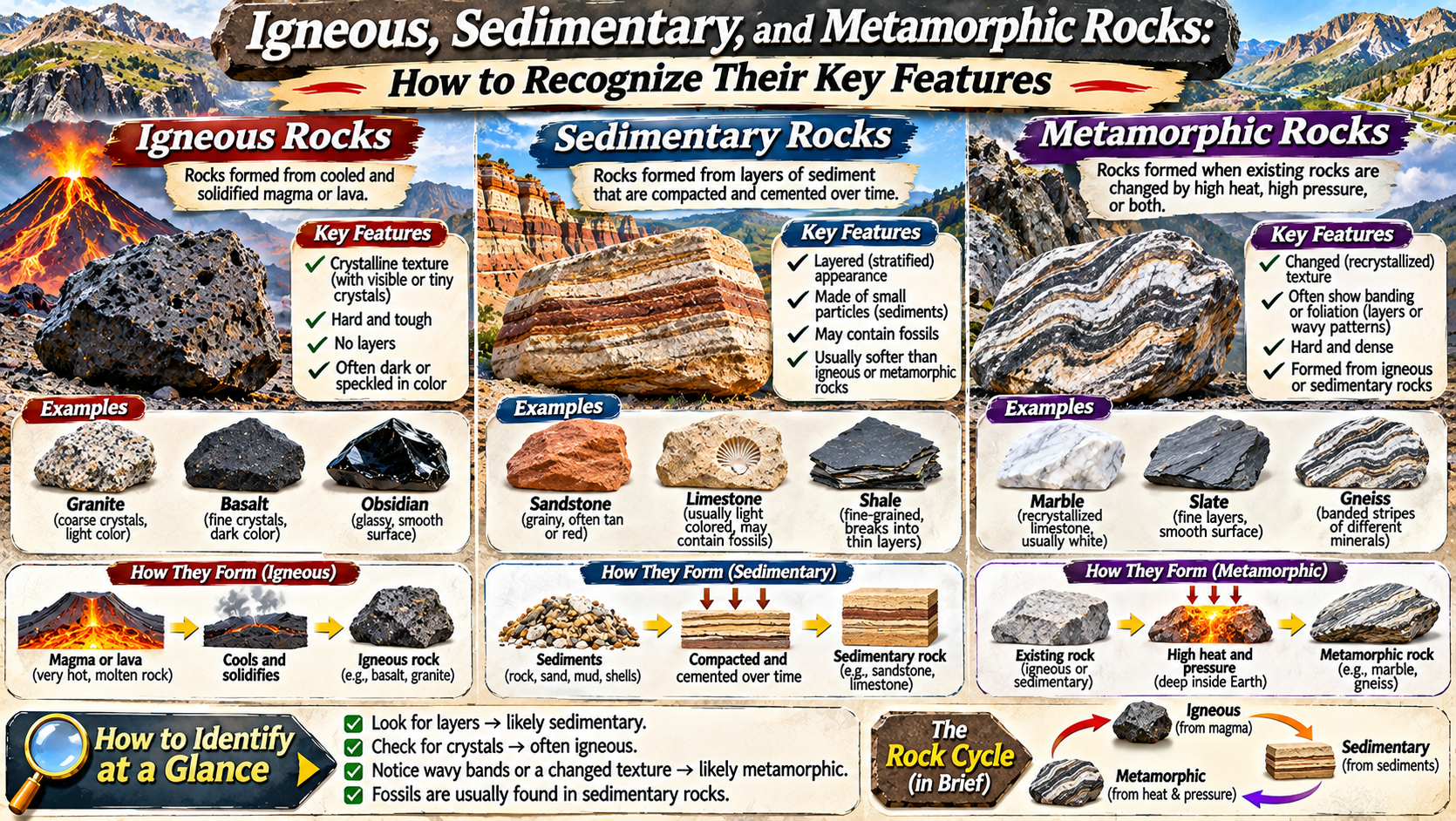
Rock classification is based primarily on how a rock formed.
Igneous rocks originate from cooling molten material.
Sedimentary rocks form through the accumulation and lithification of sediments or through chemical and biological processes.
Metamorphic rocks develop when existing rocks undergo mineralogical or textural changes under conditions different from those in which they originally formed.
Each category includes many individual rock types.
Texture, mineral composition, and geological context help distinguish them.
Formed by the cooling and solidification of magma or lava.
Formed from accumulated sediments or chemical and biological deposits.
Formed when existing rocks change under heat, pressure, or reactive fluids.
Igneous Rocks: Formed from Molten Material
Igneous rocks form when molten rock cools and becomes solid.
Molten material beneath Earth’s surface is called magma.
When magma reaches the surface through volcanic activity, it is called lava.
Cooling conditions strongly influence the texture of the resulting rock.
Magma that cools slowly underground often develops visible mineral crystals.
Lava that cools rapidly at the surface commonly forms rocks with very small crystals or glassy textures.
Intrusive Igneous Rocks
Intrusive igneous rocks form when magma solidifies beneath Earth’s surface.
Because cooling can occur slowly, mineral crystals often have time to grow large enough to be seen without magnification.
Granite is a familiar example.
It commonly contains visible crystals of quartz, feldspar, and mica.
Diorite and gabbro are other intrusive igneous rocks.
Extrusive Igneous Rocks
Extrusive igneous rocks form when lava or other erupted molten material cools at or near Earth’s surface.
Rapid cooling often produces fine-grained textures.
Basalt is a common example.
Other volcanic materials may develop distinctive textures.
Obsidian forms a volcanic glass, while pumice contains numerous gas-created holes called vesicles.
How to Recognize Igneous Rocks
Look for interlocking mineral crystals, fine-grained crystalline textures, volcanic glass, or gas bubbles preserved as holes.
Many igneous rocks lack the obvious sedimentary layering associated with deposited materials.
However, not every igneous rock has the same appearance.
Color alone is not a reliable identification method.
FIELD IDENTIFICATION / IGNEOUS
Look for Crystals, Glassy Surfaces, or Volcanic Gas Holes.
These features can provide useful clues that a rock formed from cooling molten material.
Sedimentary Rocks: Built from Layers and Deposits
Sedimentary rocks form through processes operating at or near Earth’s surface.
Weathering breaks existing rocks into smaller particles.
Erosion transports these materials through rivers, wind, glaciers, or other processes.
When sediments settle, they may accumulate in layers.
Over time, burial can compact the deposits.
Minerals dissolved in water may precipitate between grains, cementing the sediment together.
This transformation from loose sediment into solid rock is part of lithification.
Not all sedimentary rocks form from transported particles.
Some develop when minerals precipitate from water, while others accumulate from biological materials.
Clastic Sedimentary Rocks
Clastic sedimentary rocks consist mainly of fragments of preexisting rocks or minerals.
Sandstone commonly contains sand-sized grains.
Shale is a fine-grained sedimentary rock that often splits along thin layers.
Conglomerate contains rounded gravel-sized fragments held together by finer material or cement.
Breccia contains angular fragments.
Grain size and grain shape provide clues about transportation and deposition.
Chemical and Biochemical Sedimentary Rocks
Some sedimentary rocks form when dissolved substances precipitate from water.
Rock salt is an example of an evaporite deposit.
Many limestones form through the accumulation of shells, skeletal fragments, or other carbonate material produced by organisms.
Other limestones form through chemical precipitation.
These different processes explain why sedimentary rocks can have very different textures.
How to Recognize Sedimentary Rocks
Look for visible layers, rounded or angular grains, fossils, or sedimentary structures such as ripple marks.
Some sedimentary rocks contain fragments that appear cemented together.
Others have fine, uniform textures or crystalline structures.
Layering is a useful clue, but it is not present in every sedimentary rock.
FIELD IDENTIFICATION / SEDIMENTARY
Look for Layers, Sediment Grains, Fossils, and Depositional Patterns.
These features often reveal how particles or chemical materials accumulated before becoming solid rock.
Metamorphic Rocks: Changed by Heat and Pressure
Metamorphic rocks form when existing rocks undergo changes in mineral composition, texture, or both.
These changes generally occur without the rock completely melting.
Heat can promote the growth of new minerals.
Pressure and deformation can change how mineral grains are arranged.
Reactive fluids may also influence mineral transformations.
The original rock is called the protolith.
A sedimentary or igneous rock can become metamorphic when exposed to suitable conditions.
Previously metamorphosed rocks can also undergo additional metamorphism.
Foliated Metamorphic Rocks
Foliation refers to a planar arrangement of minerals or other structural features produced during metamorphism.
It can appear as parallel mineral alignment, thin splitting surfaces, or alternating bands.
Slate often has a fine-grained texture and splits along relatively flat surfaces.
Schist commonly contains visible aligned minerals, such as mica.
Gneiss often displays alternating light and dark mineral bands.
These textures can provide clues about deformation and metamorphic conditions.
Non-Foliated Metamorphic Rocks
Not all metamorphic rocks develop foliation.
Marble forms when limestone or dolostone undergoes metamorphism.
Quartzite commonly develops from quartz-rich sandstone.
These rocks may contain interlocking crystals without obvious aligned layers.
The absence of foliation does not mean the rock is not metamorphic.
How to Recognize Metamorphic Rocks
Look for aligned minerals, shiny mica flakes, mineral bands, or tightly interlocking crystals.
Some metamorphic rocks have textures that resemble other rock types.
For example, quartzite can resemble sandstone, while marble may resemble some sedimentary limestones.
Additional mineral tests and geological context may be needed for confident identification.
FIELD IDENTIFICATION / METAMORPHIC
Look for Mineral Alignment, Recrystallization, and Distinctive Banding.
These textures may indicate that an older rock was transformed by heat, pressure, or chemically active fluids.
A Practical Method for Identifying Unknown Rocks
Rock identification becomes easier when observations follow a consistent sequence.
Instead of relying on color or a single feature, examine several characteristics together.
FIELDWORK CHECKLIST / UNKNOWN SPECIMEN
Determine whether the rock contains visible crystals, separate grains, glassy material, or fine particles.
Identify sedimentary bedding, metamorphic foliation, or other structural patterns.
Fossils may suggest sedimentary origins, while volcanic gas holes can indicate igneous formation.
Look at crystal size, mineral alignment, hardness, and other visible properties.
Nearby rock formations and the surrounding landscape may provide important identification clues.
Comparing Igneous, Sedimentary, and Metamorphic Rocks
| Feature | Igneous | Sedimentary | Metamorphic |
|---|---|---|---|
| Formation | Cooling magma or lava | Deposition, lithification, or precipitation | Transformation of existing rock |
| Common Textures | Crystalline, glassy, vesicular | Grainy, layered, fossil-bearing | Foliated, banded, recrystallized |
| Fossils | Generally absent | Possible in suitable deposits | Often altered or destroyed |
| Examples | Granite, basalt, obsidian | Sandstone, shale, limestone | Slate, marble, gneiss |
How the Rock Cycle Connects All Three Groups
Rocks are not permanently fixed in one category.
Earth’s geological processes can transform one rock type into another.
Weathering and erosion break existing rocks into sediment.
Burial and lithification can turn sediment into sedimentary rock.
Heat, pressure, and reactive fluids can transform existing rocks into metamorphic rocks.
If a rock melts, the resulting magma may eventually cool and form igneous rock.
Uplift can expose buried rocks to surface weathering.
These interconnected processes form the rock cycle.
The cycle does not follow one required sequence.
A rock can experience different pathways depending on tectonic activity, erosion, burial, and other geological conditions.
Common Mistakes When Identifying Rocks
One common mistake is identifying a rock based only on its color.
Different rock types can have similar colors because they contain some of the same minerals.
Another mistake is assuming that every layered rock is sedimentary.
Metamorphic foliation can also produce visible bands or layers.
Similarly, not every crystalline rock is igneous.
Some metamorphic rocks develop large interlocking crystals during recrystallization.
Rock identification is most reliable when several observations support the same conclusion.
For difficult specimens, geologists may use thin-section microscopy, chemical analysis, or other laboratory methods.
Why Rock Identification Matters
Recognizing rock types helps scientists reconstruct Earth’s history.
Igneous rocks provide evidence of volcanic activity and the cooling of magma.
Sedimentary rocks can preserve records of ancient environments, erosion, and biological activity.
Metamorphic rocks reveal information about burial, deformation, and changes within Earth’s crust.
Rock identification is also important in construction, mining, environmental studies, and natural resource exploration.
Different rocks have different physical properties that influence how they behave under pressure, weathering, and human use.
For students and outdoor enthusiasts, learning these differences provides a practical way to understand the landscapes around them.
Frequently Asked Questions
What are the three main types of rocks?
The three main groups are igneous, sedimentary, and metamorphic rocks. They are classified primarily by how they formed.
How can you identify an igneous rock?
Look for interlocking crystals, fine-grained volcanic textures, glassy surfaces, or vesicles produced by trapped gas.
What is the easiest way to recognize sedimentary rocks?
Visible sediment grains, bedding, fossils, and depositional structures can provide useful clues, although not every sedimentary rock has these features.
How do metamorphic rocks look different?
Many show aligned minerals, foliation, banding, or recrystallized textures, but some lack obvious layering.
Can one rock change into another type?
Yes. Geological processes such as weathering, burial, metamorphism, melting, and cooling can transform rocks through the rock cycle.
Is granite igneous or metamorphic?
Granite is an intrusive igneous rock that forms when magma cools and crystallizes beneath Earth’s surface.
Why do some rocks contain fossils?
Fossils are most commonly preserved in suitable sedimentary deposits, where organisms or their traces may be buried and protected during rock formation.
Final Thoughts
Igneous, sedimentary, and metamorphic rocks record different geological processes.
Igneous rocks form through the cooling of molten material.
Sedimentary rocks develop from accumulated sediments or chemical and biological deposits.
Metamorphic rocks form when existing rocks change under heat, pressure, or reactive fluids.
Recognizing their key features requires attention to texture, mineral composition, layering, and geological context.
With practice, these observations make it easier to understand how rocks formed and what they reveal about Earth’s history.